
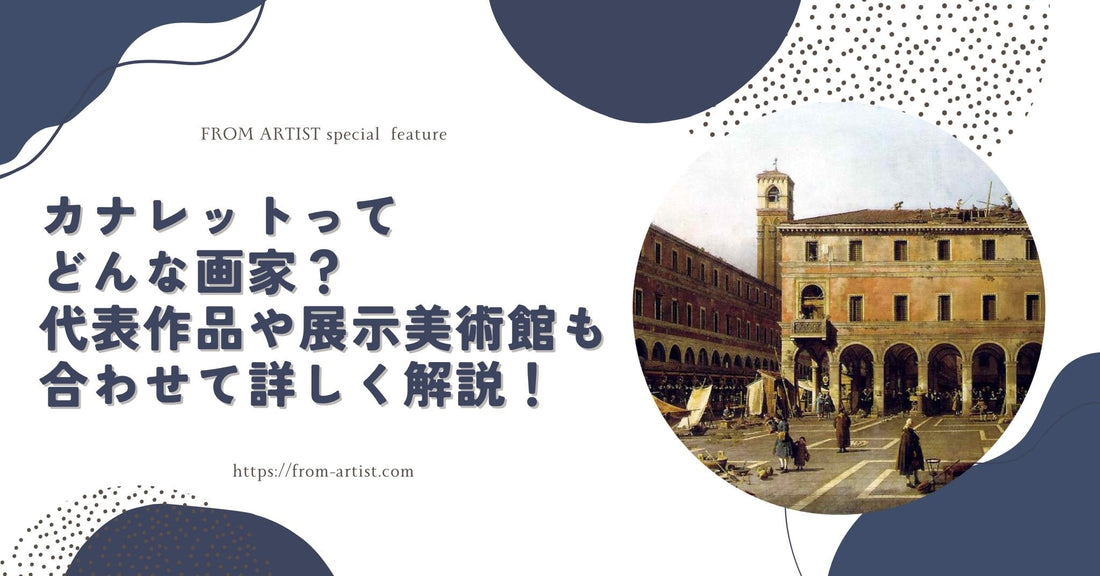
Canaletto is known as one of Italy's leading landscape painters of the 18th century. With his precise depiction and skillful use of light, he painted beautiful cityscapes of Venice, which made him immensely popular among the aristocrats who visited during the Grand Tour of the time. This article will take a closer look at Canaletto's life, his representative works, and the museums where his works are exhibited.
table of contents
About Canaletto
Representative works
exhibition museum
summary

About Canaletto
Canaletto, whose real name was Giovanni Antonio Canal, is widely known as one of Italy's leading landscape painters of the 18th century. Born on October 28, 1697, in Venice to a family of set painters, he grew up in an artistic environment from an early age. His father, Bernardo Canal, was also active as a set painter, so Canaletto was blessed with opportunities to be exposed to the world of art from an early age.
Canaletto's artistic career began by helping out in the family business. In his early career, he assisted his father in the production of stage sets. This experience is thought to have been of great help in honing his spatial composition and perspective techniques in his later landscape paintings.
The turning point came during a trip to Rome in 1719. During this trip, Canaletto was deeply impressed by the ancient ruins and architecture of Rome, and became interested in landscape painting. His experiences in Rome greatly changed his artistic outlook, and after returning home he began working full-time as a painter of Venetian cityscapes.
The greatest features of Canaletto's work are his precise depiction and skillful use of light. He had a unique technique for accurately depicting cityscapes while adding idealized beauty. For example, he subtly changed the placement of buildings and emphasized the contrast between light and shadow to create more attractive compositions. This technique made him immensely popular among the aristocrats visiting Italy on the Grand Tour of the time.
Canaletto's fame gradually spread outside of Italy, and he gained a particularly strong reputation among British collectors. As a result, he stayed in England from 1746 to 1755. During his nine-year stay, he painted many landscapes of London and the River Thames. His works in England have a different atmosphere from his previous Venetian landscapes, and are said to have had a major influence on the development of British landscape painting.
During his time in England, Canaletto also developed new techniques, such as using a camera obscura to capture landscapes more accurately. This device projected the outside scenery through a pinhole into a dark box, allowing Canaletto to accurately trace the contours of the landscape. However, his works were not simply mechanical reproductions, but were original, incorporating artistic interpretation.
Returning to Venice in 1755, Canaletto continued to paint prolifically. In 1763, he was elected a member of the Venetian Academy of Painting, solidifying his position. In his later years, Canaletto moved away from the meticulous depictions of his younger days and towards a bolder, more expressionistic style. The works of this period are characterized by a freer use of brushwork and color.
Canaletto passed away in Venice on April 19, 1768, at the age of 71. Even after his death, his works continued to be highly acclaimed and are still treasured in art museums around the world. Canaletto's paintings are also highly valued as precious documents that convey the image of 18th century Venice and London to the present day. His works, which artistically sublimate urban landscapes, are highly regarded for both historical and artistic value and continue to fascinate many people today.
Canaletto's influence extended to his contemporaries, particularly his nephew Bernardo Bellotto (commonly known as Canaletto), who inherited his uncle's style and was active throughout Europe. Venetian landscape painters such as Francesco Guardi and Michele Marieschi were also heavily influenced by Canaletto.
Even today, Canaletto's work occupies an important place in the history of art. His precise depiction techniques and unique compositions are valuable sources for understanding what cities looked like before the invention of photography. Furthermore, many of the buildings and landscapes depicted in his works are still preserved today, and by comparing them with Canaletto's paintings, we can visually understand the changes that cities have undergone.
In this way, Canaletto is not just a landscape painter, but also serves as a mirror that reflects the culture and society of 18th century Europe. Through his works, we can get a glimpse of what cities looked like in the past, and at the same time get a sense of the aesthetic sense and values of the people of that time.
Canaletto will also talk about his masterpieces.
Representative works

The Entrance to the Grand Canal, Venice
The Entrance to the Grand Canal, Venice is one of Canaletto's most famous works. This work depicts the entrance to the Grand Canal, Venice's iconic waterway, and is known as a masterpiece that showcases the artist's technical aptitude.
In this painting, Santa Maria della Salute is placed at the center, surrounded by typical Venetian architecture. Canaletto's meticulous depiction of the details of the buildings, the reflections on the water, and the movement of the clouds in the sky perfectly captures the grandeur and beauty of Venice.
Canaletto's use of light is particularly noteworthy. The way sunlight reflects off the buildings and water surface is skillfully depicted, vividly conveying the unique atmosphere of Venice. The boats and people in the foreground also provide a glimpse into the daily life of Venice at the time.
This work is a perfect example of Canaletto's signature blend of precision and idealized beauty, based on a real landscape, but with subtle adjustments to the placement of buildings and lighting to create a more captivating composition.
"The Entrance to the Grand Canal, Venice" is a work of great historical value that conveys the image of 18th century Venice to the present day, and it also occupies an important place in art history as one of Canaletto's most brilliant masterpieces.

The Piazza San Marco in Venice
"The Piazza San Marco in Venice" is one of Canaletto's most famous works, depicting St. Mark's Square, the central square of Venice. This painting is known as a masterpiece that demonstrates Canaletto's excellent technique and artistry.
This work depicts a magnificent view of St. Mark's Square in meticulous detail. At its center is the majestic Basilica of St. Mark, surrounded by meticulous depictions of the historic buildings that surround it. Canaletto renders the architectural details, the cobblestones of the square, and the activity of the people with astonishing accuracy.
Canaletto's use of light and shadow is particularly noteworthy. He skillfully depicts the sunlight streaming into the square and the shadows cast by the buildings, vividly conveying the unique atmosphere of Venice. He also meticulously depicts the people gathered in the square, making this a valuable resource for learning about the social life and clothing of the time.
This work is a fine example of Canaletto's signature blend of descriptive precision and idealized beauty: based on a real landscape, he subtly adjusted the placement of buildings and figures to create a more captivating composition.
"The Piazza San Marco in Venice" is a work of great historical value that conveys the image of 18th-century Venice to the present day, and at the same time, it occupies an important place in art history as one of Canaletto's most brilliant masterpieces. Through this work, viewers can feel the splendor and vitality of Venice's Golden Age.

St. Mark's Square
"Piazza San Marco" is one of Canaletto's most famous works. The painting depicts a magnificent view of Venice's main square, Piazza San Marco.
In this work, Canaletto meticulously depicts the architectural features of the square, placing the majestic Basilica of St. Mark in the center, surrounded by the historical buildings that surround the square, particularly the Byzantine architecture of the Basilica and the Torre dell'Orologio (Clock Tower).
What is distinctive about this work is how it beautifully captures the lively atmosphere of the square. Canaletto's detailed depictions of the people gathered in the square show the diversity of Venetian society at the time, from aristocrats to commoners. These depictions of people are valuable sources for learning about the daily life and clothing of 18th-century Venice.
Canaletto's use of light and shadow is also noteworthy. He skillfully depicts the sunlight streaming into the square and the shadows falling off the buildings, vividly conveying the unique atmosphere of Venice. This handling of light is highly regarded as a testament to Canaletto's high level of skill.
"Piazza San Marco" is one of Canaletto's masterpieces, and a fine example of his precise depiction and compositional skill. Through this work, the viewer can sense the splendor and vitality of 18th-century Venice, and it is an important historical and artistic document that conveys the image of the city at that time to the present day.

stonemason's workshop
The Stonemason's Yard is one of Canaletto's early masterpieces, painted around 1725. It is known as a rare depiction of everyday Venetian life.
The painting depicts the small square in front of the Church of Santa Maria della Carita. In the center, stonemasons are vividly depicted at work, offering a glimpse into the daily life of Venetian workers at the time.
This work is characterized by Canaletto's keen observational skills and descriptive ability. The masons at work, the details of the surrounding buildings, and the people going about their daily lives are depicted in meticulous detail. His use of light and shadow is particularly outstanding, as is the way the soft morning light envelops the entire scene.
The work is also excellent in terms of composition, with the well placed at the center of the picture, and the activities of the people and the buildings skillfully balanced around it, demonstrating Canaletto's excellent compositional skills.
"The Mason's Workshop" is one of Canaletto's early works, but it already shows his talent in full force. It gives us a glimpse into the daily life and working conditions of 18th-century Venice, and is regarded as a work of great historical and artistic value.

View of the Grand Canal
"View of the Grand Canal" is one of Canaletto's most famous works, depicting a magnificent view of Venice's main waterway, the Grand Canal. The painting is highly regarded as a masterpiece that demonstrates Canaletto's technical and artistic excellence.
This work depicts the vast landscape of the Grand Canal in meticulous detail, with astonishing precision the magnificent palaces and churches that line its banks, and the gondolas and other vessels that pass through its waters. Canaletto captures architectural details, reflections on the water, and people in action with astonishing accuracy.
Canaletto's use of light and shadow is particularly noteworthy. He skillfully depicts the sunlight reflecting off the water's surface and the shadows of the buildings, vividly conveying the unique atmosphere of Venice. He also beautifully portrays the rippling water's surface and the expanse of the sky, giving the viewer a sense of the open space of Venice.
This work is a perfect example of Canaletto's signature blend of precision and idealized beauty: based on a real landscape, he has subtly adjusted the placement of buildings and the position of the boat to create a more captivating composition.
"View of the Grand Canal" is a work of great historical value that conveys the prosperity and splendor of 18th-century Venice to the present day, and as one of Canaletto's most brilliant masterpieces, it occupies an important place in art history. Through this work, viewers can feel the splendor and vitality of Venice's Golden Age.

The Bucintoro
"The Bucintoro" is one of Canaletto's masterpieces, depicting a magnificent Venetian state ceremony. The Bucintoro was the name of the luxurious official ship used by the Doge of the Republic of Venice.
This painting depicts the annual "Marriage with the Sea" ceremony, an important event symbolizing Venice's dominance at sea. Canaletto meticulously depicts the magnificent view of the Grand Canal, with the golden Bucintoro ship at its center, and the many decorated ships taking part in the ceremony.
The work is characterized by its meticulous depiction of the details and the vivid colors that express the splendor of Venice. The lavish decoration of the Bucintoro boats, the detailed depiction of the surrounding architecture, and the reflections on the water are all examples of Canaletto's outstanding technique.
But this work is more than just a landscape: it is also a visual expression of the political and cultural power of the Venetian Republic, and through the splendor of this ceremony, Canaletto skillfully conveys the prosperity and self-confidence of Venice at the time.
"The Bucintoro" is highly regarded in art history as a crucial work for understanding Canaletto's artistic talent and the social and cultural aspects of 18th-century Venice.

The Rialto Campo
"The Campo di Rialto" (Rialto Square), one of Canaletto's masterpieces, depicts the Rialto district, the commercial centre of Venice. The painting vividly depicts the daily life and commercial activity of 18th-century Venice.
Canaletto meticulously depicts the details of the architecture and the activities of the people. In particular, the appearance of the square and the figures of the merchants vividly express the prosperity of Venice's commerce at the time.
This work is characterized by Canaletto's excellent use of perspective and the use of light. The spatial composition of the buildings and squares is precise, giving the viewer the feeling of being there. Furthermore, the skillful use of light and shadow perfectly captures the unique atmosphere of Venice.
"The Campo di Rialto" is an important work not only for the artist's artistic talent, but also for understanding the socio-economic aspects of 18th-century Venice. The painting offers a detailed look at the daily life and commercial activities of Venice at the time, making it a work of great historical and artistic value.

A Regatta on the Grand Canal
"A Regatta on the Grand Canal" is one of Canaletto's masterpieces, depicting the traditional Venetian regatta, a water sport. The painting vividly depicts the vibrant social life and culture of 18th-century Venice.
The central scene in the work is a boat race on the Grand Canal. Canaletto meticulously depicts the decorated ships taking part in the race, the buildings along the canal bustling with spectators, and the surrounding glamorous atmosphere. In particular, his depiction of the reflections and light on the water's surface is superb, skillfully capturing the unique atmosphere of Venice.
This painting is characterized by Canaletto's excellent compositional skills and attention to detail. While the powerful atmosphere of the regatta is at its center, the surrounding architecture and spectators are also depicted in great detail. The color expression of the sky and water surface is also excellent, and it beautifully captures Venice's bright sunlight and its characteristics as a city of water.
"A Regatta on the Grand Canal" is more than just a landscape painting. It is a visual record of Venice's cultural traditions, social customs, and urban prosperity. It is also highly regarded as an important historical document that conveys to the present day the vitality and splendor of Venice at that time through the traditional regatta.
Through this work, the viewer is able to immerse themselves in the festive atmosphere of 18th-century Venice and gain a detailed insight into the social life of that time. A perfect example of Canaletto's exceptional technique and artistry, "A Regatta on the Grand Canal" occupies an important place in art history as one of his masterpieces.

Perspective View with Portico
"Perspective View with Portico" is one of Canaletto's masterpieces and an important example of his mastery of architectural depiction and perspective. The painting depicts an imaginary classical building and is a brilliant demonstration of Canaletto's artistic imagination and technical mastery.
The work is characterized by its precise depiction of architecture and its masterful use of perspective. At its center is a magnificent portico, with the buildings and landscape beyond it depicted in perfect perspective. Canaletto's skillful use of light and shadow gives the architecture a sense of volume and depth.
This work demonstrates that Canaletto was not merely a landscape painter, but also had a deep understanding and interest in architecture, and the fusion of his imagination and real-life architectural knowledge results in an idealized classical architectural space.
"Perspective View with Portico" occupies an important place in art history as a work that highlights Canaletto's technical skills. Through this work, the viewer can sense his exceptional ability to compose space and his meticulous attention to detail when depicting architecture. The work also reflects the interest in classical architecture in 18th-century Italy, making it a valuable resource for understanding the artistic trends of the time.
exhibition museum
Canaletto's works can be seen in famous museums around the world. Due to his artistic value and historical importance, many museums own and exhibit his works. Below we introduce some of the most representative exhibition facilities.
First of all, the National Gallery in London is known as a museum that houses many of Canaletto's important works. Here, you can enjoy his meticulous depiction techniques and unique expression of light, focusing on Venetian landscape paintings. In particular, you can see Canaletto's masterpieces, such as "The Building of Westminster Bridge" and "View of the Grand Canal," up close. Through these works, you can get a vivid sense of what Venice and London were like in the 18th century.
The Galleria dell'Accademia in Venice, Italy, is another important venue for the exhibition of Canaletto's work. Viewing his work in a museum in the artist's hometown of Venice is a special experience. Here, you can gain a deeper understanding of how Canaletto depicted the city in which he was born and raised. Works such as "Festival in St. Mark's Square," for example, offer a glimpse into the vibrant social and cultural life of Venice at the time.
The Metropolitan Museum of Art in New York also has Canaletto's works in its collection. This museum offers an opportunity to experience Canaletto's art outside of Europe, and you can see works such as "St. Mark's Square with a View of the Piazzetta." This is a good opportunity to understand how Canaletto's work has been internationally acclaimed and collected.
In addition to Canaletto's works, the Dresden State Gallery of Old Paintings also exhibits works by his nephew, Bernardo Bellotto (also known by the nickname "Canaletto"). Comparing the works of the two artists allows for a deeper understanding of Canaletto's art. In particular, by viewing Canaletto's paintings of Venice and Bellotto's paintings of Dresden side by side, you can observe the similarities and differences in their techniques.
The Kunsthistorisches Museum in Vienna also has an important collection of Canaletto's works, where you can see his later works, such as "View from the Riva degli Schiavoni," and through these you can understand how his artistic style developed and changed.
Furthermore, Canaletto's works are also on display at the Hermitage Museum in St. Petersburg, which is an important testament to the Russian court's interest in European art, and here you can get a real sense of the international acclaim for his work.
By visiting these museums, you can gain a deeper understanding of Canaletto's artistic world and experience its fascination firsthand. Each museum presents his work from a different perspective, so visiting multiple museums will allow you to gain a more comprehensive understanding of his art. Furthermore, these museums allow you to see not only Canaletto's works but also those of other artists from his time, helping you to grasp the overall picture of 18th-century European art.
Finally, when visiting these museums, we recommend checking the websites of each museum for the latest exhibition information. Some museums hold special exhibitions or planned exhibitions that focus on Canaletto's works, so it's important not to miss these opportunities. Many museums also offer audio guides or guided tours, which can help you gain a deeper understanding of Canaletto's work.
summary
We have introduced the painter Canaletto, including his life, his representative works, and the major museums where his works are exhibited. As one of Italy's leading landscape painters of the 18th century, Canaletto continues to fascinate many people with his meticulous depiction techniques and unique expression of light.
His works are more than just landscapes; they are also important as precious records of the society, culture and architecture of his time. The fact that Canaletto's works can be found in famous museums around the world is proof of the universal appeal of his art.
If you have the opportunity, be sure to visit the museum and see Canaletto's work in person.
[Official LINE Exclusive 🎧]
Learn more about the world of the work through the artist's voice.
The artist himself talks about the background and concept of the production.
An art channel exclusively for purchasers of “FROM ARTIST” is now available!
▼Official LINE here (for customers only)
https://line.me/ti/p/%40517rkxah
Currently, "FROM ARTIST" has over 700 artists .
New paintings are added every day 🌼
Check out the latest works and more on the official LINE account
We will be introducing featured artists from time to time, so
Please add us as a friend 👩🏻🎨🧑🏻🎨✨
▼FROM ARTIST Customer-only LINE
https://line.me/ti/p/%40517rkxah
▼Click here for LINE for artists
https://line.me/ti/p/%40433xxkes
▼Official website
https://from-artist.com
About the author
 Author: Shiori
FROM ARTIST management staff. They write feature articles and columns, and provide operational support from an artist's perspective.
 Supervisor: Shoma Toida
CEO of BUSCA LLC. Head of FROM ARTIST. Started his career as a marketer, he worked for a business company and an advertising agency before going independent. He completed marketing-related programs at several graduate schools and business schools, including the University of California, Berkeley and London Business School. He also completed the MBA core curriculum at Macquarie University and studied the importance of art in education at the University of British Columbia.
#Painter #Watercolor #Oil #Landscape #Canvas Art #Acrylic Painting #Painting #Abstract Painting #Art #Painter #Artist #Art #Graphic Art #Digital Art #Illustrator #Fluid Art #Contemporary Art #Museum #Art College Student #Solo Exhibition #Artwork #Painting #Autumn of Art #I want to connect with painters #Living with paintings #Painting Appreciation #Artists Wanted
